
Research Contributions
My research lies at the intersection of artificial intelligence, data science, graph learning, optimization, and materials informatics. Across recent years, I have focused on developing original computational methods and AI-driven frameworks that connect methodological novelty with real scientific and engineering applications. Below are selected contributions that highlight key directions of my work, including graph-based learning on metal–organic frameworks, nature-inspired optimization, and the integration of large language models into materials science workflows.
Black Hole Strategy
The Black Hole Strategy introduces a gravity-inspired representative sampling framework for frugal graph learning on metal–organic framework (MOF) networks. The core idea is to identify highly informative and structurally representative nodes, enabling graph learning systems to operate effectively with reduced data while preserving important relational patterns.
This contribution is particularly relevant for scientific domains where data labeling is expensive and complete graph supervision is often unrealistic. By combining graph structure awareness with efficient sampling, the method supports more scalable and resource-aware learning in materials discovery settings.

MOFGalaxyNet
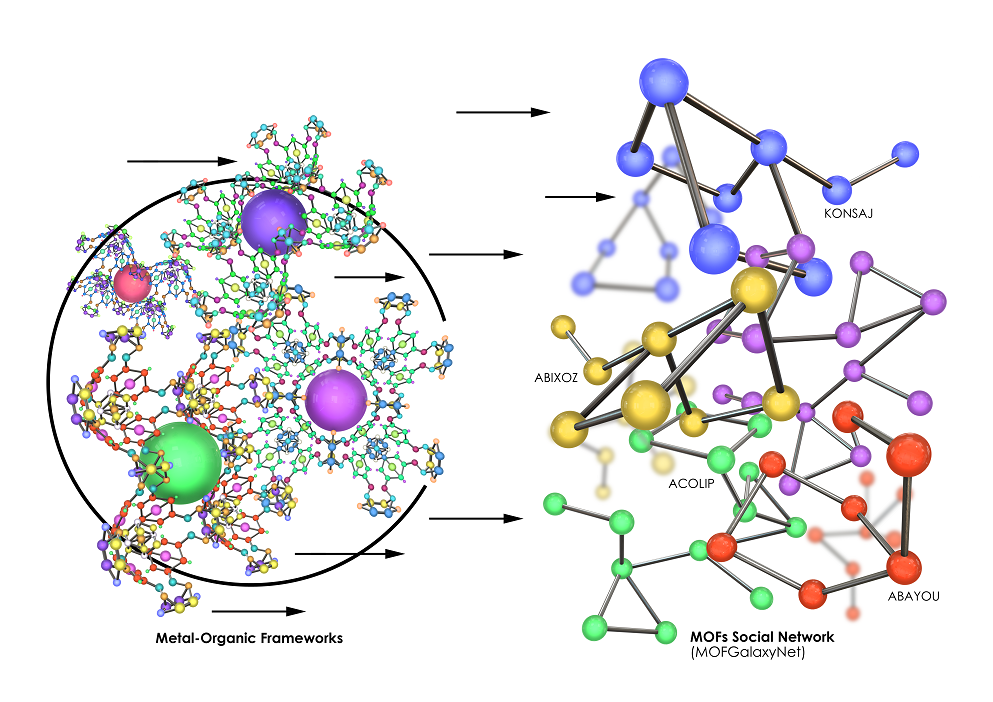
MOFGalaxyNet is a graph convolutional learning framework designed to predict guest accessibility in metal–organic frameworks through a social-network-inspired view of materials. Instead of treating MOFs as isolated objects, this work models them as interconnected entities whose structural relationships can reveal hidden patterns relevant to adsorption and accessibility behavior.
This work represents one of my key contributions to AI for materials science, showing how graph neural networks and network science can be combined to support scientifically meaningful predictions in porous materials research.
SOCIAL
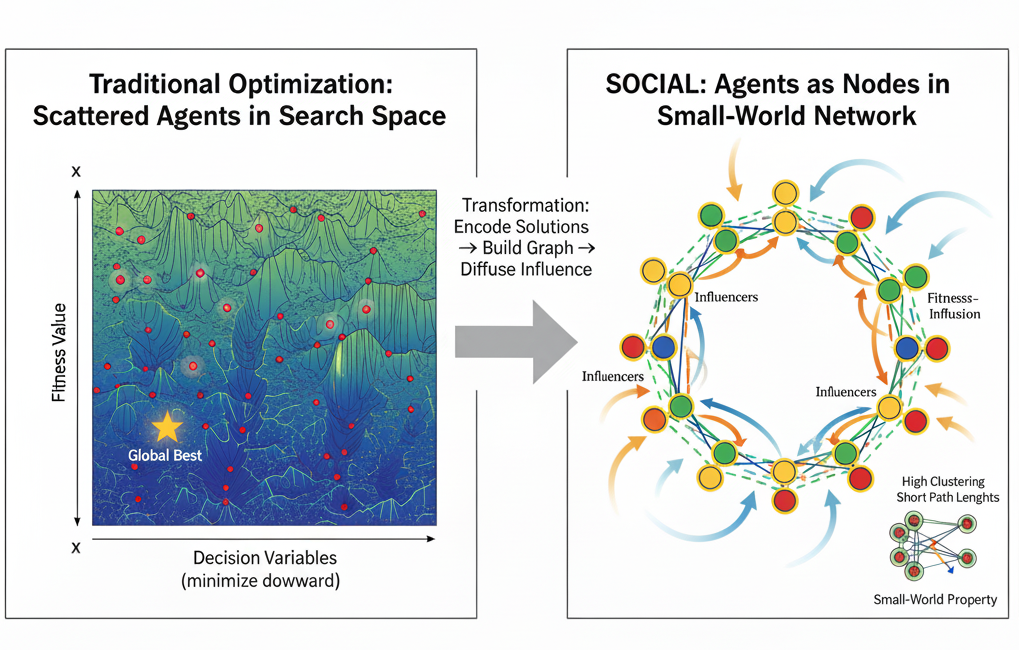
SOCIAL is a social network optimization algorithm developed around the principles of centrality, influence, and interaction-aware learning. In this framework, candidate solutions evolve not only through numerical search, but also through network-informed dynamics inspired by how influence spreads and how important actors shape collective behavior in social systems.
The contribution of SOCIAL lies in introducing a more interpretable and structurally meaningful optimization perspective, bridging metaheuristic design with concepts from social network analysis. It is intended for challenging optimization problems where balanced exploration and exploitation are essential.
Lotus Effect Optimization Algorithm (LEA)
The Lotus Effect Optimization Algorithm (LEA) is a nature-inspired optimization method motivated by the self-cleaning and adaptive characteristics associated with the lotus effect. LEA was proposed as a novel metaheuristic for engineering design and complex optimization tasks, offering a fresh search mechanism grounded in natural inspiration while targeting strong practical performance.
This work contributes to my broader research theme of designing original optimization frameworks that are both conceptually distinctive and practically relevant. LEA also became a foundation for later extensions and application-oriented variants in optimization and intelligent systems.

MOF-LENS
MOF-LENS extends bio-inspired optimization into the domain of nanocarrier discovery for cancer therapy. The framework applies lotus-effect-inspired search principles to accelerate the identification of promising metal–organic framework candidates for doxorubicin delivery, linking optimization theory with a highly relevant biomedical and materials science application.
This work is an example of how my research aims to move beyond algorithm development alone by demonstrating how intelligent computational approaches can support real scientific discovery pipelines in advanced materials and health-related applications.

Large Language Models in Materials Science
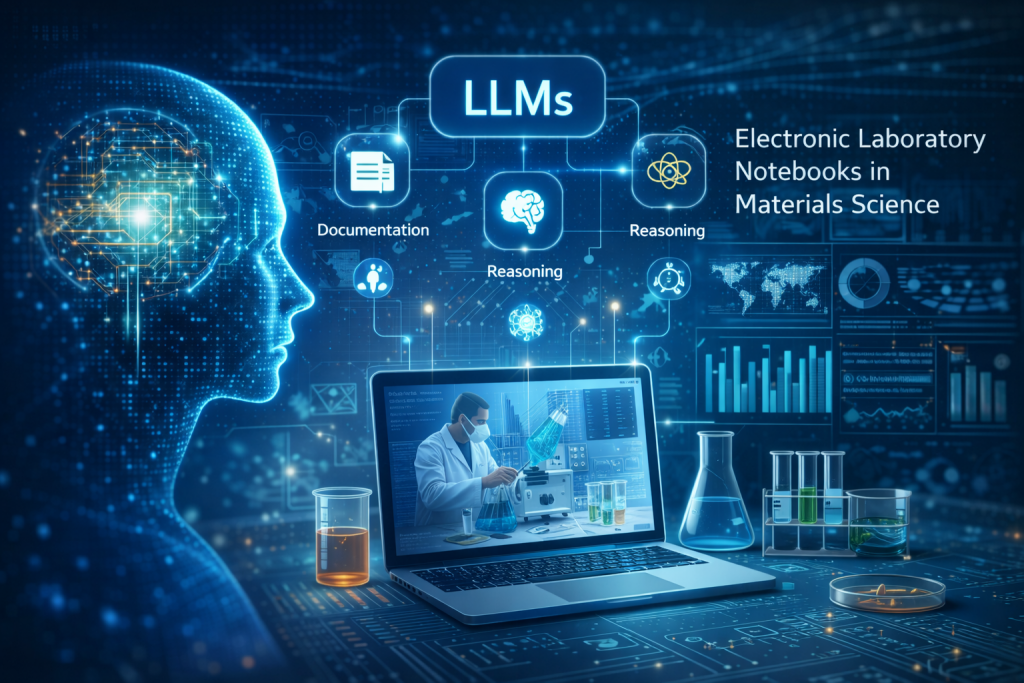
In my Elsevier publication on large language models in electronic laboratory notebooks, I explored how LLMs can transform materials science research workflows by supporting documentation, knowledge extraction, scientific reasoning assistance, and more intelligent interaction with laboratory records.
This contribution reflects an important direction in my recent work: integrating generative AI and language models into scientific environments in ways that are practical, domain-aware, and capable of improving research efficiency. It also connects my interests in AI systems, scientific data workflows, and domain-specific intelligence for materials research.
Explore More Publications
These selected works reflect only part of my broader research activity across artificial intelligence, materials informatics, graph learning, optimization, and computational data science. For a complete and updated list of publications, citations, and research metrics, please visit my Google Scholar profile.
View Google Scholar